PSA Birth Certificate Authentication Guide for International Use
A PSA birth certificate issued on security paper is fully valid for domestic transactions across the Philippines but the moment you need to use it in another country, a single document is rarely enough on its own. Foreign governments, embassies, and international institutions require an additional layer of official verification before they will accept a Philippine civil registry document as legally valid within their jurisdiction. If you ordered your birth certificate PSA online and are now preparing it for use abroad for immigration, employment, education, dual citizenship, or legal proceedings this guide covers every step of the authentication process, from understanding which type of authentication applies to your situation through to submitting the finalized document.
Why Authentication Is Required for International Use
A PSA birth certificate carries the authority of the Philippine government within the Philippines. Outside the Philippines, foreign governments have no automatic mechanism to verify that the document is genuine, that the issuing authority exists, or that the signature and seal on the document belong to a legitimate official.
Authentication bridges this gap. It is the process by which an authorized Philippine government body, primarily the Department of Foreign Affairs, certifies that the document is genuine and that the official who signed or sealed it holds the position claimed. Once authenticated, the document carries the DFA’s own seal and certification, which foreign governments recognize as a reliable guarantee of the document’s legitimacy.
Failing to properly authenticate a PSA birth certificate before submitting it abroad is one of the most common reasons foreign visa applications, immigration petitions, and overseas employment documents are rejected or returned for correction. Understanding the correct process and specifically which process applies to the country you are dealing with prevents this entirely avoidable setback.
The Two Authentication Pathways: Apostille vs. Consular Authentication
The most important distinction in the entire authentication process is understanding which of the two pathways applies to your situation. The country you are submitting the document to determines which pathway you follow.
Pathway 1: Apostille Certification (For Hague Convention Member Countries)
The Philippines joined the Hague Apostille Convention on May 14, 2019. Under this convention, a single Apostille certificate issued by the DFA is sufficient to make a Philippine document legally recognized in any other Hague Convention member country; no further authentication steps are required.
As of 2026, major Hague Convention member countries include the United States, Canada, Australia, the United Kingdom, Germany, France, Italy, Spain, Japan, South Korea, the Netherlands, New Zealand, and most other European Union member states. A full list is maintained by the Hague Conference on Private International Law if you are unsure whether your destination country is a member, verify this before choosing your authentication pathway.
The Apostille process is significantly simpler and faster than the older consular authentication process. It eliminates the need for multiple sequential verification steps and has become the default authentication method for most overseas employment, immigration, and legal transactions involving Philippine documents.
Pathway 2: Consular Authentication / Red Ribbon (For Non-Hague Countries)
For countries that are not members of the Hague Apostille Convention, the older multi-step authentication process applies. This process is sometimes called consular authentication or, informally, “red ribbon” a reference to the red ribbon that was historically used to bind authenticated documents before the Apostille system was adopted.
Countries that are not Hague Convention members and therefore require consular authentication include many in the Middle East, certain African nations, and some Asian countries. The consular authentication process involves the DFA authenticating the document first, followed by legalization at the target country’s embassy or consulate in the Philippines.
Step-by-Step: Apostille Certification Process
For documents being sent to Hague Convention member countries, the Apostille process involves the following steps.
Step 1: Obtain a Fresh PSA Birth Certificate
The document you present for Apostille must be an original PSA-issued birth certificate on security paper (SECPA). A photocopy, even a clear one, is not accepted for Apostille processing.
Order a fresh copy of your PSA birth certificate through at any PSA Serbilis outlet. Most DFA Apostille guidelines recommend presenting a copy issued within the last six months, though this requirement varies by destination country. Confirm the specific recency requirement with the embassy or institution you are submitting to before ordering.
Step 2: Book a DFA Apostille Appointment
The DFA processes Apostille certifications at its main offices and select consular offices. DFA Apostille appointments are booked through the official DFA online appointment system.
Available processing sites include:
- DFA Office of Consular Affairs (OCA) in Aseana, Paranaque City the main processing center
- DFA Regional Consular Offices in Cebu, Davao, Iloilo, and other major cities
- Select DFA satellite offices at partner mall locations
Book your appointment well in advance particularly during peak periods when appointment slots at the Aseana office fill up quickly.
Step 3: Prepare the Required Documents
For DFA Apostille processing of a PSA birth certificate, bring:
- Original PSA birth certificate on security paper
- Accomplished DFA application form (available at the DFA office or downloadable from the DFA portal)
- Valid government-issued ID of the applicant
- Appointment confirmation slip
- Payment of the Apostille fee
For documents being processed on behalf of someone else, a Special Power of Attorney (SPA) or authorization letter may be required. Confirm the DFA’s current third-party processing requirements before your appointment.
Step 4: Pay the Apostille Fee and Submit
The Apostille fee for standard processing is generally in the range of ₱200 per document, though fees are subject to change. Express or rush processing is available for an additional fee. Always check the current fee schedule on the DFA’s official website or by calling the DFA hotline before your appointment.
At your appointment, submit the document, accomplish the required forms, and pay the fee. The Apostille certificate is attached to or affixed on your PSA birth certificate.
Step 5: Receive the Apostille-Certified Document
Standard processing time: 3 to 5 working days after submission.
Express / rush processing: Same-day or next-day processing is available for an additional fee, subject to availability at the processing site.
The completed document, your PSA birth certificate with the DFA Apostille certificate attached is the final product. No further authentication is required for submission to any Hague Convention member country..
Step-by-Step: Consular Authentication Process
For documents being sent to countries that are not members of the Hague Apostille Convention, consular authentication follows a sequential multi-agency process.
Step 1: PSA Birth Certificate (Starting Point)
Same as the Apostille process to obtain a fresh, original PSA birth certificate on security paper.
Step 2: DFA Authentication
The DFA’s Office of Consular Affairs authenticates the PSA birth certificate by verifying the dry seal and signature of the PSA official who issued the document. This DFA authentication is the first official seal on the document.
The process and appointment booking are the same as the Apostille process. At this stage, however, you are requesting standard DFA authentication not Apostille so confirm this distinction when booking and submitting your documents.
Step 3: Authentication at the Target Country’s Embassy or Consulate
After the DFA authenticates your document, it must be further legalized by the embassy or consulate of the country where you intend to use the document. Present the DFA-authenticated birth certificate to the relevant embassy or consulate in the Philippines.
Each embassy has its own procedures, fees, and processing times for document legalization. Contact the specific embassy directly for their current requirements. Some embassies require additional steps such as translating the document into the official language of the destination country and having the translation certified before presenting it for legalization.
Step 4: Certified Translation (If Required)
Many non-English-speaking destination countries require that the PSA birth certificate be translated into their official language by an accredited translator before submitting for legalization. The translation must typically be:
- Performed by an accredited or certified translator
- Notarized or certified as accurate
- Submitted alongside the original Philippine document for simultaneous legalization
Check with the destination country’s embassy for their specific translation requirements before commissioning a translation.
Special Situations in PSA Birth Certificate Authentication
OFW Documents for POEA / DMW Processing
Overseas Filipino Workers processing their documents through the Department of Migrant Workers (formerly POEA) for overseas employment require an Apostille on their PSA birth certificate for deployment to most countries. The authentication process is the same as described above but the urgency is often higher due to deployment deadlines.
OFWs should process their Apostille at least four to six weeks before their intended departure date to allow time for any complications in the process.
Dual Citizenship Applications
Filipinos who have naturalized abroad and wish to reacquire their Filipino citizenship under Republic Act 9225 often need their PSA birth certificate authenticated for the reacquisition process at a Philippine Consulate abroad. The specific authentication requirements for RA 9225 applications vary by consulate contacting the relevant consulate for their current document requirements.
Immigration Petitions to the United States
For US immigration petitions filed with USCIS (U.S. Citizenship and Immigration Services), PSA birth certificates used as supporting documents generally require Apostille certification because the United States is a Hague Convention member. However, USCIS also accepts certified translations for non-English documents. Both the Apostille-certified original and a certified English translation are typically submitted together.
Marriage of Filipino Citizens Abroad
When a Filipino citizen is marrying abroad and needs their birth certificate as part of the legal documentation, the destination country’s requirements determine the authentication pathway. Most European countries which are Hague Convention members require an Apostilled birth certificate. Some countries additionally require an original Certificate of No Marriage (CENOMAR) from PSA, also with Apostille certification.
Documents for Academic Applications Abroad
Filipino students applying to universities abroad frequently need Apostille-certified PSA birth certificates as part of their applications. The same standard Apostille process applies. Some universities additionally require certified translations to check each institution’s specific document requirements.
Getting the PSA Birth Certificate Authenticated When You Are Abroad
For Filipinos who are already overseas and need to have their PSA birth certificate authenticated, there are two main approaches.
Approach 1: Have Someone Process It in the Philippines on Your Behalf
Authorize a trusted family member or friend in the Philippines to handle the PSA document request and DFA Apostille processing on your behalf. They will need:
- Your authorization letter or Special Power of Attorney
- A photocopy of your valid ID
- Their own valid ID
- The completed DFA application forms and fees
The authenticated document is then sent to you abroad via international courier to arrange this in advance with your authorized representative.
Approach 2: Request Authentication Through a Philippine Embassy or Consulate Abroad
Philippine Embassies and Consulates abroad provide notarial and authentication services for Philippine nationals. However, the scope of services varies by post; not all consulates provide Apostille services directly. Many consulates can authenticate documents for use in the host country if the Philippines and that country have a bilateral agreement.
Contact your nearest Philippine Embassy or Consulate directly to determine what authentication services they currently offer and what documents are required.
Note on Processing Times from Abroad
When coordinating authentication from overseas, allow significantly more time than domestic processing. International mail, inter-office coordination, and customs clearance all add to the timeline. Building in six to eight weeks for the complete process from PSA birth certificate ordering through to receiving the authenticated document abroad is a conservative but realistic estimate for most situations.
Common Mistakes That Delay or Void Authentication
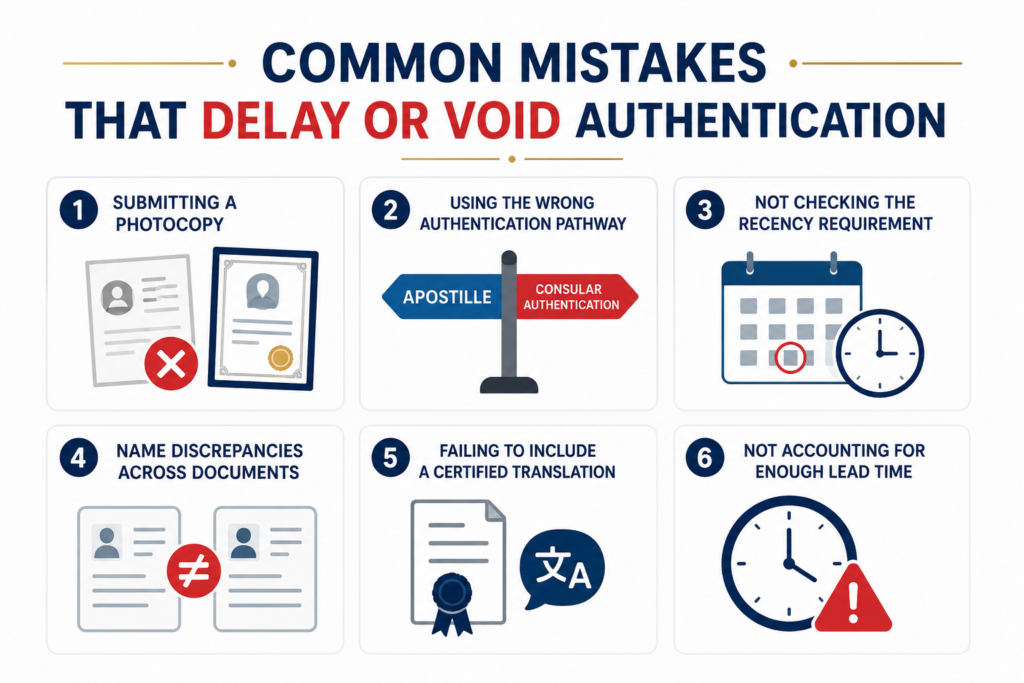
Submitting a photocopy instead of an original. The DFA only accepts original PSA birth certificates on security paper (SECPA) for Apostille and authentication processing. A photocopy, even a notarized one, is returned without processing.
Using the wrong authentication pathway. Submitting a document for Apostille when the destination country requires consular authentication or vice versa results in a document that the foreign institution will not accept. Always verify the destination country’s membership in the Hague Convention before beginning.
Not checking the recency requirement. Some embassies and foreign institutions require a PSA birth certificate issued within the last six months. Submitting an older copy may result in rejection even after successful Apostille processing. Order a fresh copy before beginning authentication if your existing copy is more than six months old.
Name discrepancies across documents. If the name on the PSA birth certificate differs from the name on your passport or other submitted documents even by a single letter or the inclusion/exclusion of a middle name the authentication may proceed, but the receiving foreign institution may reject the document package for inconsistency. Resolve name discrepancies through the LCR correction process before pursuing authentication.
Failing to include a certified translation. For countries whose official language is not English, submitting an Apostille-certified document without a certified translation results in rejection at the foreign institution. Always verify translation requirements before the authentication step.
Not accounting for enough lead time. Both standard DFA processing (three to five working days) and consular authentication can be extended by public holidays, appointment backlog, or peak demand periods. Starting the authentication process at least four to six weeks before any hard submission deadline is strongly recommended.
Authentication Fees and Processing Times Summary
| Process | Fee (Approximate) | Standard Processing Time |
| PSA Birth Certificate (online) | ₱365 per copy | 3-7 business days (delivery) |
| PSA Birth Certificate (walk-in) | ₱155 per copy | Same day |
| DFA Apostille (standard) | ~₱200 per document | 3-5 working days |
| DFA Apostille (express) | Higher fee | Same day to next day |
| DFA Consular Authentication | ~₱200 per document | 3-5 working days |
| Embassy Legalization | Varies by embassy | Varies 1 to 10 working days |
| Certified Translation | ₱500-₱2,000+ per page | 1-5 working days |
All fees are subject to change. Verify current amounts at the DFA before your appointment.
Frequently Asked Questions
Does my PSA birth certificate need to be authenticated for submission within the Philippines?
No. Authentication is only required when a PSA birth certificate is being submitted for use in another country. For domestic transactions, school enrollment, government benefits, passport applications the original PSA-issued birth certificate on security paper is sufficient without any DFA authentication.
How do I know if the country I am submitting to is a Hague Convention member?
The Hague Conference on Private International Law maintains the authoritative list of member countries. You can also confirm with the relevant embassy or consulate in the Philippines, or ask the foreign institution you are submitting to whether they accept Apostille or require consular legalization.
Can I get my PSA birth certificate authenticated if it has annotations from a name correction?
Yes. An annotated PSA birth certificate, one where a correction was made through RA 9048, RA 10172, or a court order can be authenticated through the same DFA Apostille or consular authentication process. The annotation is part of the official document and does not disqualify it from authentication. Ensure you are using the current, corrected name throughout all submitted documents for consistency.
Is a single Apostille sufficient for multiple submissions abroad, or do I need a separate Apostille for each institution?
An Apostille certificate is document-specific; it certifies the specific document it is attached to. If you need to submit authenticated birth certificates to multiple institutions or for multiple purposes, you will need a separate authenticated copy for each submission. Order the number of PSA copies you need and process each one through the DFA.
How long is an Apostille-certified PSA birth certificate valid?
There is no expiration on the Apostille certification itself. However, the PSA birth certificate it certifies remains subject to the recency requirements of the receiving institution. Many embassies and foreign agencies require the underlying PSA document to have been issued within the last six to twelve months, regardless of when the Apostille was processed. If a significant amount of time has passed since authentication, ordering a fresh PSA copy and having it re-apostilled may be necessary.
Final Thoughts
Authenticating a PSA birth certificate for international use is a straightforward process once you know which pathway applies to your destination country. For the vast majority of countries Filipino citizens deal with immigration to the US, Canada, Australia, and Europe; employment in Japan or Korea; academic applications across the EU; the Apostille certification from the DFA is all that is needed. It takes three to five working days and costs a minimal fee. The key habits that make the process smooth are simple: order a fresh PSA birth certificate before beginning, verify whether your destination country requires Apostille or consular authentication, book your DFA appointment well in advance of your submission deadline, and confirm translation requirements with the specific institution you are submitting to. Start early, prepare carefully, and your authenticated PSA birth certificate will be ready for any international transaction immigration, employment, education, or legal with documents that any foreign authority will accept with confidence.