How to Retrofit Older Properties With Centralized Water Leak Monitoring Across Concealed Plumbing Networks
The short answer is to combine a smart meter on the main supply with point sensors at every high-risk fixture, then tie them together with one controller that can shut the water off automatically. The meter watches for unusual flow, the sensors catch drips where they start, and the controller acts in seconds, even when the house is empty. In an older property with plumbing hidden behind plaster and under floors, that combination turns an invisible leak into a phone alert and a closed valve instead of a ruined ceiling.
Older homes hide their plumbing well, and that is exactly the problem. Galvanised and copper runs snake through wall cavities, under floorboards, and behind tiled bathrooms, and a slow leak can soak timber and plaster for months before anyone sees a stain. Water damage claims routinely run into the thousands, and a single burst pipe while the house is empty can do far worse. A centralized monitoring retrofit does not replace the old pipes, but it makes sure no leak goes unnoticed long enough to matter.
Why Concealed Plumbing in Older Homes Leaks Without Warning
Age is the quiet enemy of concealed plumbing. Galvanised steel pipes corrode from the inside, copper joints fatigue with decades of thermal movement, and flexible supply hoses to toilets and washing machines harden and crack. None of this is visible from the outside, because the pipework is buried behind finishes that were never designed to be opened. The first sign of trouble is often a damp patch on a ceiling two rooms away from the actual leak, by which time the water has travelled along joists and soaked insulation.
Finished basements and modern renovations make the problem worse by hiding even more pipework. A 1970s house with a finished basement can conceal dozens of joints behind drywall, and a leak there may only reveal itself when the floor above starts to smell musty. The pattern is always the same: the leak starts small, the damage compounds silently, and the repair bill covers both the plumbing and the finishes. Monitoring does not prevent the leak, but it catches it while the fix is still small.
What a Centralized Leak Monitoring System Actually Does
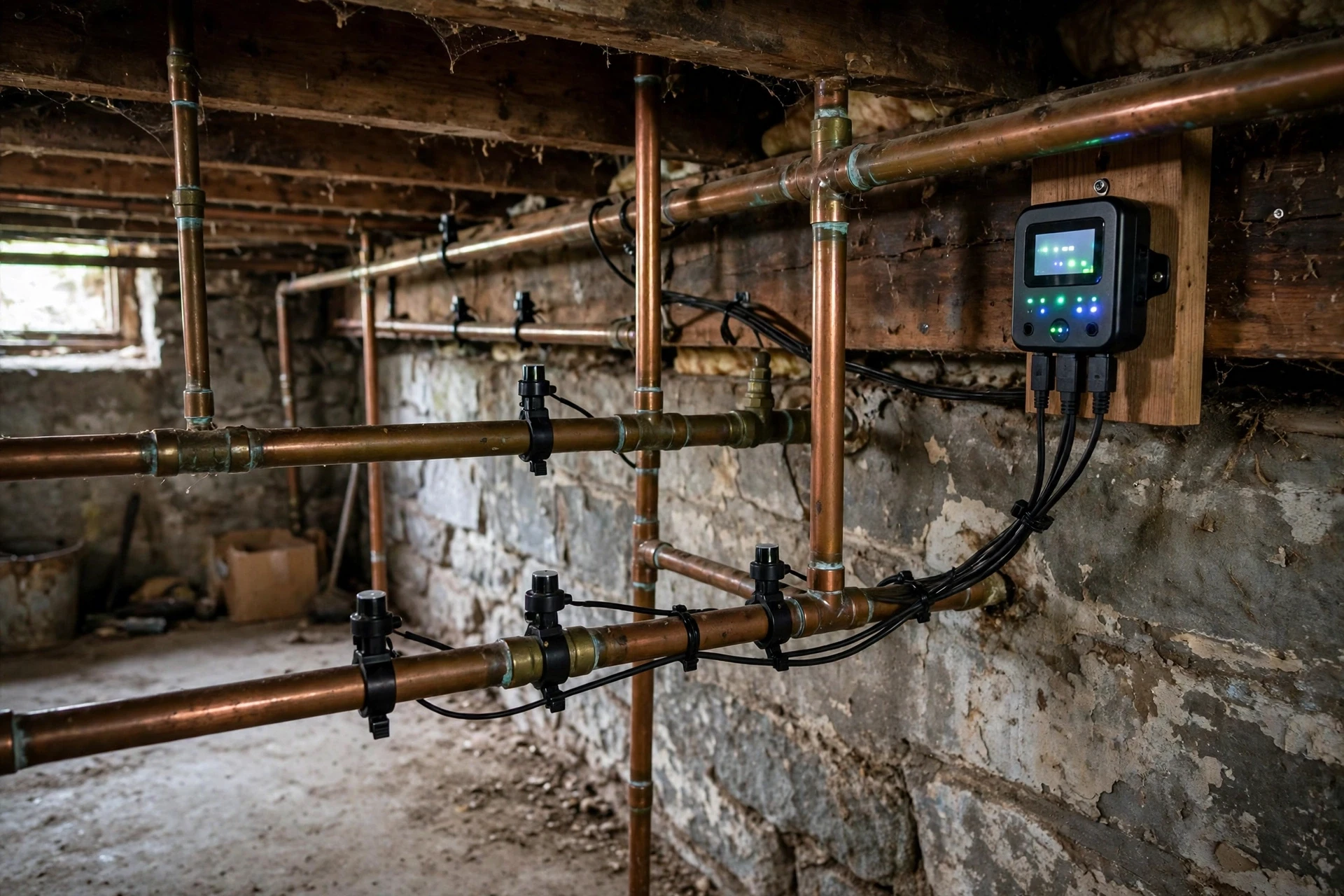
A centralized system has three parts that work together. Point sensors sit where leaks start: under sinks, behind washing machines, at the water heater, near the dishwasher, and in the sump pit. A smart meter or flow monitor sits on the main supply and learns the household's normal water use, flagging continuous low flow that suggests a hidden leak. A controller ties them together, sending alerts to a phone and, most importantly, closing an automatic shutoff valve on the main when a sensor goes wet or the flow pattern looks wrong.
The shutoff valve is what separates a real system from a collection of beeping pucks. A sensor in an empty basement can only chirp, and nobody hears it, but a valve closes the water in seconds and stops the damage at its source. Some systems also watch for freezing conditions and unusual pressure, and many can be checked remotely, which matters most when the house sits empty during holidays or between tenants. The whole point is that the house protects itself whether anyone is home or not.
Mapping the Hidden Pipework Before You Buy Anything
Retrofitting a monitoring system starts with a map, not a shopping list. Walk the house with a torch and a notepad and trace the plumbing as far as you can: where the main enters, where it branches to bathrooms and the kitchen, where the water heater sits, and where supply lines disappear into walls. Note the age and material of visible pipework, because galvanised runs and old flexible hoses deserve sensors nearby even when they look sound.
- Find the main shutoff and meter first, since the flow monitor and automatic valve both live there.
- List every wet appliance and fixture, from the dishwasher to the fridge supply line, and rank them by leak risk.
- Note which pipes run through finished spaces, because those are the ones a hidden leak will damage most.
- Check for existing access panels, cleanouts, and inspection hatches that make sensor placement easier.
- Photograph the visible pipework before finishes go back, so future work starts with answers instead of guesses.
This map decides where the money goes. A sensor under every sink matters more than a sensor in a dry hallway, and a flow monitor on the main is worth more than a dozen sensors in the wrong places. Spend an hour mapping before spending anything on hardware, and the system you build will cover the real risks instead of the obvious ones.
Choosing Between Wired, Wireless, and Hybrid Sensor Networks
Sensor networks come in three flavours, and the right one depends on the house. Wired sensors are the most reliable: they never need batteries, they report instantly, and they are hard to interfere with, but they need cable runs that can be awkward in a finished older home. Wireless sensors are far easier to retrofit, sticking under sinks and behind appliances with no drilling, but they need battery changes and a solid signal through walls and floors.
Most older properties end up with a hybrid. Wired sensors cover the mechanical room, the water heater, and anywhere a cable run is easy, while wireless sensors cover the scattered fixtures where running cable would mean opening finished walls. The controller should speak both, and it should keep working during a power cut, because a leak does not wait for the electricity to come back. Whatever the mix, every sensor should report to one place, so a single dashboard or app shows the whole house at a glance.
| Sensor type | Strengths | Weaknesses | Best placed |
|---|---|---|---|
| Wired spot sensor | No batteries, instant reporting | Needs cable runs | Mechanical room, water heater |
| Wireless puck sensor | Easy retrofit, no drilling | Batteries, signal limits | Under sinks, behind appliances |
| Cable sensor | Covers long pipe runs | Costs more per metre | Along concealed pipe routes |
| Smart flow meter | Catches hidden slow leaks | Needs main access | On the main supply |
Placing Sensors Where Leaks Actually Start
Leaks do not start at random. They start at joints, connections, and appliances, and the sensor map should follow that reality. Water heaters, dishwasher and fridge supply lines, washing-machine hoses, toilet supplies, and sump pits are the usual suspects, and each one deserves a sensor sitting directly beneath it or beside its lowest joint. A sensor a metre away from the leak is a sensor that finds out too late.
- Water heater pan and drain get a sensor first, since heater failures release large volumes fast.
- Under every sink and toilet supply place a puck where drips will pool before they spread.
- Behind the washing machine and dishwasher put sensors at hose level, where a split hose sprays first.
- At the sump pit and any low point in the basement, catch rising water before it reaches stored goods.
- Along concealed risers run a cable sensor where pipes pass through floors and ceiling voids.
It is tempting to add sensors everywhere, but coverage beats quantity. A sensor at each genuine risk point, tested and labelled, protects the house better than a drawer full of unplaced pucks. Walk the route after installation and confirm that every sensor sits where water would actually collect, not where it was simply convenient to stick one.
Installing the Automatic Shutoff Valve on the Main
The automatic shutoff valve is the heart of the system, and it belongs on the main supply, just after the meter and the manual shutoff. A licensed plumber should make this connection, because it involves cutting into the main and the valve must be sized to the pipe and rated for continuous service. Once fitted, the valve stays open in normal use and closes only when the controller tells it to, or when someone triggers it from the app.
Test the valve properly before trusting it. Trigger a sensor with a damp cloth and watch the valve close, then confirm the water stops at a tap and the alert arrives on the phone. Check that the valve can also be operated manually, because there will be days when the power is out or the controller needs attention. A valve that has never been tested is a valve you are only hoping will work, and hope is a poor defence against a burst pipe at two in the morning.
Connecting Alerts, Apps, and Remote Monitoring
Alerts are only useful if they reach someone who can act. The controller should send notifications to the homeowner's phone by app, text, or email, and ideally to a second person as well, so a leak while the owner is travelling still gets a response. The alert should say which sensor triggered, what the flow reading was, and whether the valve has closed, because a vague warning wastes the minutes that matter.
- Name every sensor by its location, so an alert reads as kitchen sink rather than sensor seven.
- Set up a second contact for alerts, covering holidays and times the owner cannot respond.
- Test alerts monthly by wetting a sensor and confirming the message arrives within seconds.
- Keep the controller on a backed-up power supply, so it keeps working through an outage.
Some systems can also send alerts to a monitoring centre or a trusted neighbour, and a few integrate with home automation platforms so the leak response can switch off a water-fed appliance at the same time. Keep the setup simple enough that it still works when the internet is down, and simple enough that a house-sitter can understand it. The best alert system is the one that fires, reaches someone, and makes the next step obvious.
| Retrofit step | Who does it | Rough effort | Priority |
|---|---|---|---|
| Map pipework and risks | Homeowner | An afternoon | First |
| Fit flow meter and valve | Licensed plumber | Half a day | Essential |
| Place point sensors | Homeowner or installer | A few hours | Essential |
| Connect controller and alerts | Homeowner or installer | An hour | Essential |
| Test, label, and document | Homeowner | An hour | Before relying on it |
Maintaining the System So It Works When It Matters
A monitoring system is only as good as its last test. Wireless sensor batteries need replacing on schedule, and a dead sensor is worse than no sensor because it creates false confidence. Flow meters need their baseline relearned when the household changes, for example after a new bathroom or a long holiday, or the system will cry wolf over normal use. Put a monthly test on the calendar and treat it like checking a smoke alarm.
Keep the documentation where the next person can find it. A one-page sheet inside the mechanical room, listing every sensor location, the valve position, the controller login, and the plumber's number, turns a midnight emergency into a short job. Photograph the sensor positions as well, because a sensor hidden behind a washing machine is invisible to the person who needs to find it. A maintained, documented system is the difference between a leak that costs a mop and a leak that costs a renovation.
Centralized Leak Monitoring FAQs: Retrofits, Sensors, and Shutoff Valves
Can I retrofit leak monitoring without opening finished walls?
Yes, in most cases. Wireless sensors stick under sinks and behind appliances with no drilling, and a flow meter clamps onto the main supply. The only part that usually needs a plumber is the automatic shutoff valve on the main. Cable sensors can be fished through accessible voids, but opening walls is rarely necessary for a good retrofit.
How does a smart flow meter find a hidden leak?
It learns the household's normal water use and watches for flow that does not fit, such as a small continuous flow through the night when nobody is using water. That pattern is the signature of a slow leak in concealed pipework. The meter flags it, and the controller can alert you or close the valve before the damage spreads.
Will the automatic valve shut off my water by mistake?
A well-set-up system rarely does, because it learns normal use before it starts acting on anomalies. Most systems let you set thresholds and add a delay, so a long shower or filling a bath never triggers a shutoff. Test the settings for a few weeks and adjust them before relying on automatic shutoff while you travel.
Do I need a plumber for the whole installation?
You need a licensed plumber for the shutoff valve tie-in to the main, because that involves cutting into the supply. Sensors, the controller, and the app setup are straightforward homeowner or low-voltage installer work. Many homeowners place the sensors themselves and bring in the plumber for half a day to fit the valve and check the main.
How much does a whole-home leak monitoring retrofit cost?
Costs vary widely with the size of the house and the number of sensors, but a typical single-family retrofit is a modest investment compared with the cost of one serious water-damage repair. Budget for the valve and plumber time, the flow meter, and a sensor at each high-risk fixture. Many insurers offer premium discounts for homes with automatic shutoff, which helps offset the cost over time.
Final Thoughts: Centralized Leak Monitoring That Watches While You Sleep
Retrofitting centralized leak monitoring is one of the highest-value upgrades an older home can receive. Map the pipework, place sensors where leaks actually start, fit a flow meter and an automatic valve on the main, and test the whole system until you trust it. The pipes will still be old, but they will no longer be unwatched. When the next joint weeps or the next hose splits, the house will notice first, act first, and tell you about it before a small leak becomes a major repair.