Channel Trading: Mapping Ascending and Descending Market Corridors
Navigating the financial markets without a clear structural boundary can feel like driving through heavy fog without any lane markers on the road. Price action frequently travels inside organized, parallel pathways rather than moving in completely chaotic bursts. Learning how to draw and trade these ascending and descending corridors gives you an incredibly reliable map to forecast exactly where prices are likely to bounce or break.
What exactly is a price channel, and how do I spot one on my chart?
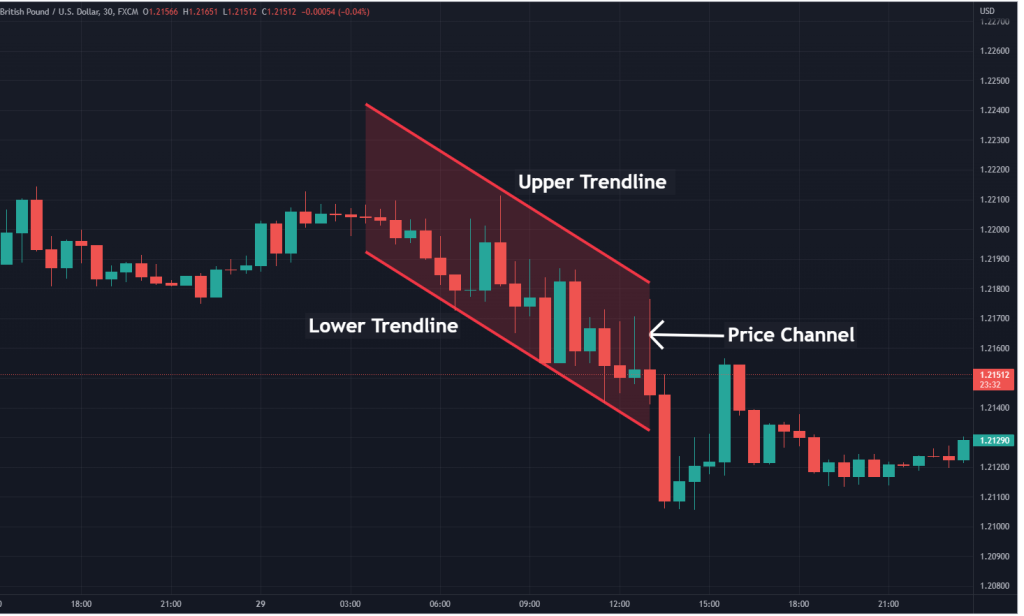
A price channel is a technical chart pattern created by drawing two parallel trendlines that completely contain an asset’s price action. The lower line acts as a moving support boundary, while the upper line serves as a sloped ceiling of resistance.
Think of this structure exactly like a tennis ball bouncing back and forth between the floor and the ceiling of a narrow hallway. In an ascending corridor, the market prints consecutive higher highs and higher lows, slanting upward. A descending channel slopes downward, carving out a clear rhythm of lower highs and lower lows. Spotting these corridors requires looking for at least two major reaction points on the top and two on the bottom. When you map these lines on an advanced platform provided by a reliable best forex broker for mt5, you instantly transform a messy chart into a clean, highly scannable playground.
How do I draw these corridors accurately without forcing the lines?
Getting your boundaries right requires patience and a strict adherence to real market turning points. Start by finding the dominant trendline first. For an ascending corridor, draw a straight line connecting the major structural swing lows.
Once your baseline is firmly anchored, use your platform’s cloning tool to create an exact, perfectly parallel copy of that line. Slide that cloned line upward until it rests neatly on top of the prominent swing highs that formed between those lows. Always make sure the lines touch the outer edges of the candle wicks rather than slicing through the middle of the candles. If you have to tilt or warp the cloned line to make it fit the tops, the channel is probably invalid. A true corridor reveals itself naturally without needing any mathematical manipulation from the trader.
Should I trade both sides of the corridor, or should I stick to one direction?
While it is tempting to try and profit from every single bounce inside the parallel lines, the smartest approach is trading exclusively in the direction of the dominant macro trend. If you are mapping an ascending channel, focus all your energy on buying the bounces at the channel floor.
Trying to short the ceiling of an uptrend is an incredibly dangerous gamble because you are fighting the primary momentum of the market. The upward bursts are usually swift and aggressive, while the downward pullbacks tend to be choppy and short-lived. If you are currently building out your baseline best forex trading platform for beginners experience, sticking to trend-aligned entries keeps your risk profile safe. You let the counter-trend moves happen without you, waiting patiently for the asset to return to a high-probability discount zone.
What is the correct way to set my risk and targets inside a live channel?
Managing your risk inside these market pathways is highly mechanical because the lines give you explicit invalidation points. When buying a bounce off an ascending channel floor, your protective stop-loss belongs just a few pips below the outer support line.
This tight placement ensures that if the market breaks the structure, you are cut out of the position immediately with only a minor scratch to your balance. Your primary profit target should rest just below the opposite parallel boundary line. Because channels slope over time, your price targets actually adjust dynamically the longer the trade takes to develop. This structured setup creates an exceptional risk-to-reward ratio, ensuring that your winning trades are significantly larger than your occasional, unavoidable losses.
How do I handle a sudden breakout where price snaps through the channel line?
When price aggressively breaks out of a mapped corridor, it signals a major shift in the underlying balance of market power. Many novice traders panic during a breakout, assuming they missed the entire move, or they immediately try to fade it.
The safest play is waiting for the market to complete a formal structural retest of the broken line. Suppose the price surges violently above the resistance ceiling of a descending channel. Once the initial breakout candle closes outside, wait for a minor pullback to drop back down and test the outer side of that same broken line. If that old resistance ceiling successfully converts into a fresh floor of support, you have verified institutional backing. This retest zone provides a beautiful, low-risk entry window to catch the birth of a fresh, powerful trend.
Practical Takeaway
Open your charting software and analyze your favorite currency pairs across the four-hour and daily timeframes to locate three active price corridors. Avoid entering trades in the middle of a channel where the market has equal room to move in either direction. Instead, place pending limit orders right at the outer boundaries where the trendline support or resistance overlaps with historical horizontal values. By forcing yourself to execute exclusively at these extreme structural zones, you will dramatically lower your entry costs and give your capital the protection it needs to expand stably.