Why Are Some Kitchen Countertops More Likely to Develop Stains Around Frequently Used Areas?
You wipe the same countertop every day, yet the ring around the coffee maker keeps coming back, the strip beside the sink looks duller than the rest, and the patch next to the stove seems to attract every splash. The rest of the worktop still looks new, so the problem feels personal. It is not. Stains gather around frequently used areas for a physical reason: those are the places where spills happen most often, sit longest, and meet a surface whose protection has already worn thinnest.
Kitchen countertops stain around frequently used areas because those zones combine the three things a stain needs: a steady supply of pigment, oil, acid, or minerals; repeated contact that gives liquids time to soak in; and a sealer that wears out fastest exactly where hands, water, and heat land every day.
The Short Answer: Busy Zones Give Stains More Chances, More Time, and a Weaker Shield
Think of a stain as a small accident that needs opportunity. A quiet stretch of countertop beside the fruit bowl may see one spill a month, wiped up within seconds. The landing zone beside the sink sees dozens of wet hands, dripping dishes, and soap suds every day, and some of that moisture is never wiped at all.
Frequency matters as much as the spill itself. A single splash of red wine on a sealed surface usually wipes away cleanly, but the same splash repeated weekly, on a spot where the sealer has thinned from scrubbing and hot pans, eventually finds its way into the stone. There is also a difference between a mark sitting on the surface and a stain inside the material: surface residue, such as dried coffee film or hard-water scale, comes off with the right cleaner, while a true stain has soaked into pores or reacted with the finish.
What Porosity Actually Means Inside a Kitchen Countertop Slab
Natural stone is not a solid sheet of glass. Granite, marble, quartzite, and limestone are made of mineral crystals pressed together over geological time, and microscopic gaps remain between those crystals. Those gaps form a network of tiny channels running through the slab. Engineers call this porosity, and it varies enormously: dense, dark granites have a tight structure with little room for liquid, while light-coloured marble and limestone are far more open.
When liquid sits on porous stone, capillary action pulls it downward into those channels, much like water climbing into a sponge. Pigment travels with it, and oil is especially stubborn because it does not evaporate. Engineered quartz works differently: crushed quartz bound with resin leaves essentially no open pore network, which is why quartz resists staining so well without ever needing a sealer. Laminate sits in between. Its plastic surface resists most stains, but its seams, edges, and any chip expose the absorbent board underneath, and that is where laminate staining usually starts.
The Four Stain Families That Show Up Around Busy Kitchen Zones
Not every mark around the sink or stove is the same kind of damage, and treating them all the same way is a common reason cleaning fails. Most kitchen countertop stains fall into four families:
- Pigment stains. Coffee, tea, red wine, turmeric, and tomato sauce carry strong colour that settles into pores when left to dry. These are the brown, yellow, and pinkish marks near coffee makers and prep areas.
- Oil and grease stains. Cooking oil and greasy splatter darken stone from the inside out, often like a shadow that spreads slowly. They are worst beside the cooktop, where hot oil splashes and sits.
- Acid etching. Lemon juice, vinegar, and tomato do not stain marble and limestone so much as dissolve them, leaving a dull, pale spot. Etching is not dirt, so scrubbing it only makes the dull patch larger.
- Mineral deposits. Tap water carries dissolved calcium and magnesium. When a puddle evaporates beside the faucet, the minerals stay behind as white, chalky rings or a cloudy film, usually on the surface rather than absorbed.
Why the Sink, the Cooktop, and the Coffee Corner Stain First
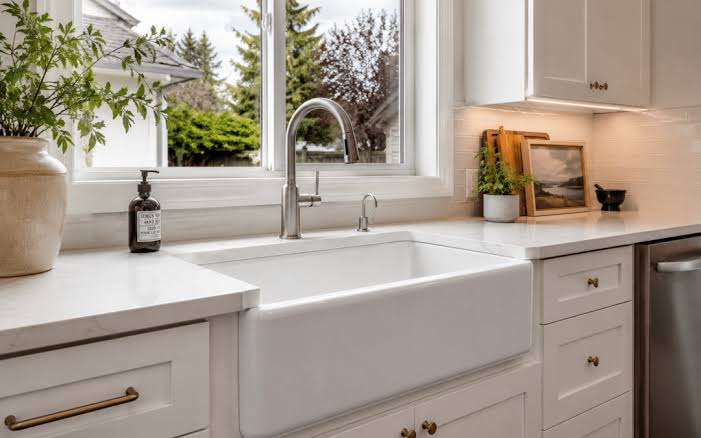
Around the sink, water is the constant: hands drip, dishes drain, and the rim stays damp long after washing up. The seam where the sink meets the countertop is a particular trap, since moisture, soap scum, and minerals collect in that joint.
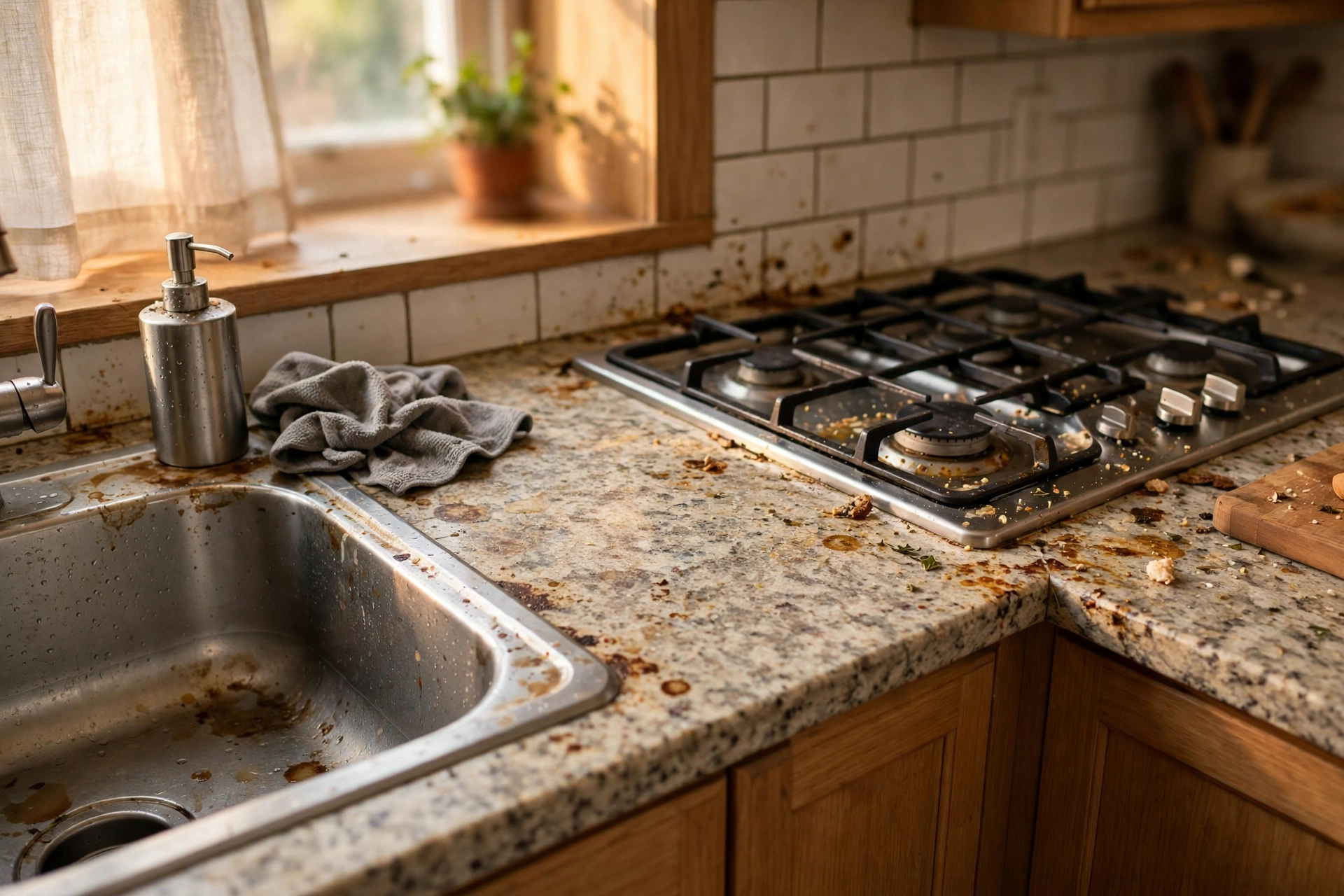
Beside the cooktop, the enemies are oil and heat. Frying sends fine droplets across the nearest stretch of worktop, nearly invisible on a busy pattern, and over weeks they build into a sticky film that traps dust and darkens. The same zone sees hot trays set down in a hurry, which wears the sealer thin. The coffee corner and prep area collect pigment instead: mug rings, coffee maker drips, and juice left in tiny scratches, where grooves hold liquid longer than the smooth surface around them.
Kitchen Countertop Materials Ranked by How Readily They Mark Around Daily Use
Material choice is the single biggest predictor of whether a busy zone will stain. The table below compares the common options on the factors that matter most.
The pattern is clear: nonporous surfaces stain least in busy zones, but they are not invincible. Quartz can scorch, laminate can fail at a seam, and porcelain can hold residue in a textured finish.
How a Worn Sealer Turns a Spill Into a Permanent Mark
Most natural stone countertops leave the fabricator with a penetrating sealer soaked into their pores. A penetrating sealer does not coat the surface like varnish; it lines the pore walls and slows absorption, buying you time to wipe up a spill before it sinks in. That protection is temporary. Scrubbing, acidic cleaners, hot pans, and constant water wear it away fastest exactly where the kitchen is busiest, which is why the same countertop can repel a spill on a quiet stretch and absorb it beside the sink.
- You can test this in under a minute with the water bead test:
- Clean and dry a small patch in the busy zone, such as beside the sink.
- Place a few drops of plain water on the surface and start a timer.
- Watch for ten minutes. If the water stays beaded and the stone does not darken, the sealer is still working.
If the stone darkens within a few minutes, the sealer has worn through there and it is time to reseal before the next stain sets in.
Repeat the test in a quiet area too. If the busy zone fails and the quiet zone passes, you have found your staining explanation. When resealing, work on a clean, dry surface, apply a penetrating sealer made for your stone type, let it dwell as the label directs, and wipe off all excess, since sealer left to dry on the surface often leaves a hazy film.
Lifting a Fresh Mark Versus a Set-In Stain: A Zone-by-Zone Cleanup Routine
Identify the mark. White and chalky means mineral deposit; dark and spreading means oil; brown or pink rings mean pigment; dull and pale on marble means etching, not dirt.
Clean the surface first. Warm water with a drop of pH-neutral dish soap on a soft microfiber cloth, then rinse and dry completely. Many apparent stains are only surface film and disappear at this step.
Treat mineral rings gently. On quartz, laminate, or porcelain, diluted white vinegar can dissolve scale. On marble, limestone, or granite, avoid vinegar and use a cleaner approved for your stone.
Draw oil out with a poultice. Spread a paste of baking soda and water over the mark, cover with plastic wrap, and leave it for 24 hours so the paste pulls the oil back out.
Dry the zone and retest. A stain that penetrated usually means the sealer failed there, so reseal that patch.
Stop if the mark grows, the surface feels rough or pitted, or the colour changes after cleaning. Those are signs of etching or damage below the surface, and further scrubbing will only widen the problem.
When a Stain Means the Countertop Needs a Stone Professional, Not Another Scrub
Call a stone restoration professional if the stain covers a large area, if a poultice has failed twice, if the surface is etched across a wide patch, or if the stone feels rough, cracked, or hollow near a seam or sink cutout. A cracked seam or a loose sink rim can let water into the cabinet below, which is a leak problem, not a cosmetic one. Professionals can diamond-polish etching away and apply deep poultice treatments homeowners cannot. As a rough guide, a professional stain or etch repair visit is typically estimated in the low hundreds of dollars, while full resurfacing runs higher. Wear gloves when handling poultice chemicals and never mix bleach with other cleaners.
What Stain-Resistant Countertops Cost to Buy and Keep Looking New
If stains keep returning despite good habits, the honest question is whether the material suits the way you cook. As broad installed-price estimates, engineered quartz and granite commonly fall in a similar mid-range per square foot, porcelain and quartzite often cost more, and laminate costs far less. A penetrating sealer for do-it-yourself application is typically estimated in the tens of dollars per bottle, while hiring a professional to seal a kitchen is usually estimated in the low hundreds of dollars. Before replacing a stained countertop, price the middle options: professional polishing can erase etching and surface staining for far less than a new slab.
Kitchen Countertop Stain Questions Homeowners Ask Before Replacing a Worktop
Why does my countertop stain near the sink but nowhere else?
The sink zone stays wet longest, its sealer wears fastest from constant water and soap, and hard-water minerals accumulate every time a puddle evaporates. Spills in that one strip meet a weaker shield and more standing moisture than spills anywhere else on the same slab.
Can a stain that has been there for months still be removed?
Sometimes. Pigment and oil stains can often be lightened with repeated poultice treatments, even after months, but very old oil stains and deep mineral crusts may only fade rather than vanish. If two poultice attempts produce no change, the mark is likely permanent and professional polishing is the next step.
Does sealing a countertop make it completely stain-proof?
No. A penetrating sealer slows absorption and buys you time to wipe up spills; it does not make stone nonporous and it does not stop acids from etching marble. Sealed stone still needs prompt wiping, and the sealer must be tested and renewed as it wears.
Why do light countertops seem to stain more than dark ones?
Light stone is often more porous, and pigment shows more strongly against a pale background. Dark stone hides early marks better, but it shows white mineral deposits more clearly, so each colour simply reveals a different kind of stain first.
Is it safe to use vinegar on my stained countertop?
It depends on the material. Diluted vinegar can dissolve mineral scale on quartz, laminate, and porcelain, but it etches marble and limestone and strips sealer from granite. When in doubt, use a pH-neutral cleaner approved for your surface and test any new product on a hidden spot.
Should I replace a countertop that keeps staining, or just reseal it?
Reseal first if the water bead test shows the sealer has failed and the stains are recent. Replacement makes sense when stains return despite fresh sealer and good habits, when etching covers a large area, or when the material itself is a poor match for how you use it.
Choosing Your Next Move: Live With the Marks, Restore the Surface, or Replace the Zone
Stains around frequently used areas are rarely a mystery once you read them correctly. They tell you where water stands, where oil lands, where pigment dries, and where the sealer gave up first. That diagnosis points straight to the fix: dry the sink rim, protect the cooktop landing zone, test the sealer in the busy patches, and treat each mark according to its family.
Start this week with the water bead test beside your sink and your cooktop. If the water soaks in, reseal those patches and watch whether new marks slow down. If stains persist on freshly sealed stone, bring in a stone professional before the damage spreads. And if you are choosing a new countertop, let your busiest zone choose the material.