Two-Way Radios in Mexico: A Complete Guide to Choosing the Right Equipment at RadioRed
When it comes to staying connected in environments where a cell phone simply isn’t enough — a construction site, a boat out at sea, an air traffic control tower, or an industrial plant with explosive atmospheres — two-way radios remain, and will remain for a long time, the most reliable tool available. At RadioRed, we’ve spent years helping companies, government agencies, private marinas, and hobbyists across Mexico find the right equipment, from the right brands, at the right price.
Why keep investing in radios when everyone has a cell phone?
It’s a question we hear often. The answer is simple: coverage, durability, and control. A portable radio doesn’t depend on a cell tower or a phone plan; it operates on a private, closed network that you fully control. In rural areas of the Bajío region, in remote sites in Sonora or Chihuahua, or simply inside a building with thick walls where cell signal drops out, a well-configured radio paired with the right repeater keeps working when the phone no longer does.
On top of that, instant group communication — pressing one button to talk to the entire team at once — has no real equivalent in the cellular world, not even with the most modern push-to-talk apps.
Portable Radios: The Heart of Any Operation
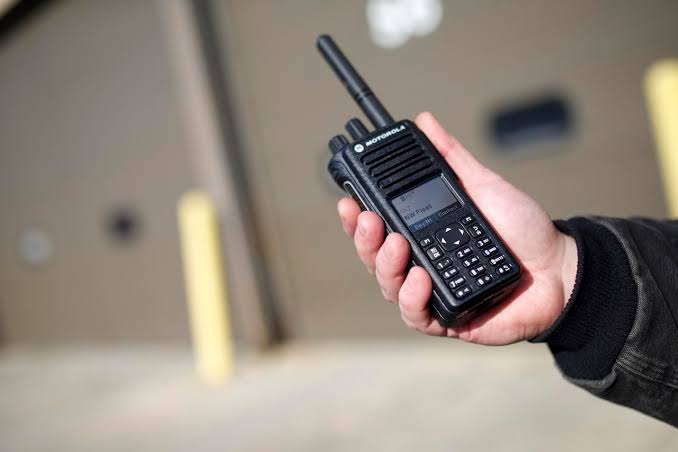
Portable radios remain the most requested product in our catalog, and that’s no coincidence. Brands like Kenwood, ICOM, and Motorola have evolved their lineups to offer lighter equipment, longer battery life, and digital protocols (DMR, NXDN) that enable text messaging, built-in GPS, and encrypted communication.
For the commercial and private security sectors, digital portables have stopped being a luxury. They allow staff to be split into channels and talk groups, provide real-time location tracking for each radio, and in many models, include an emergency button that alerts the entire fleet if a team member needs help.
If your operation is simpler — a restaurant, a department store, an event — mid-range analog radios remain an excellent choice thanks to their cost-to-value ratio and ease of use.
Mobile Radios: Long-Range Communication for Fleets
When we talk about vehicles — cargo trucks, security units, private ambulances, or delivery fleets — mobile radios are essential. They’re installed directly in the vehicle, connected to its battery, which gives them significantly more transmission power than a portable unit. Combined with a repeater, they can cover distances of several kilometers even across mountainous terrain.
Marine Radios: Safety Out at Sea
For those navigating the Gulf of Mexico, the Pacific, or the Sea of Cortez, a VHF marine radio isn’t optional — it’s a matter of safety. These units are built to withstand humidity, salt water, and extreme marine conditions, and include Channel 16, dedicated exclusively to distress calls and coordination with the Mexican Navy (Secretaría de Marina).
Aviation Radios: Precision for Pilots and Control Towers
In the general aviation sector, having a certified aviation radio is essential for communication between pilots and control towers. Our catalog includes portable units specifically designed for this frequency band, offering the audio clarity and battery life that aeronautical operations demand.
Intrinsically Safe Radios: For Hazardous Environments
In refineries, chemical plants, mines, and any environment where there’s a risk of explosion from gases or combustible dust, a conventional radio can pose a real danger. Intrinsically safe equipment is certified to avoid generating sparks or enough heat to trigger ignition, meeting international standards such as ATEX and IECEx. This is one of the categories we emphasize most with our industrial clients: not every radio is suitable for every environment, and this decision directly impacts personnel safety.
Repeaters: Extending Your Coverage
A solid radio communication system rarely stops at portable or mobile units — the repeater is what truly multiplies the range of the entire operation. Installed at a high point — a rooftop, a tower, a hill — the repeater receives the signal from radios and retransmits it at higher power, allowing units that normally couldn’t hear each other to communicate without issue. For companies operating across multiple points in a city, or even between distant industrial plants, this is the investment that makes the difference.
Accessories You Shouldn’t Overlook
A radio is only as good as the accessories that support it. Lapel microphones for security personnel, spare batteries and multi-unit chargers for large fleets, rugged cases and clips for heavy-duty use, and higher-gain antennas to extend coverage — each of these elements can transform the daily experience of using a radio.
Trends Shaping the Future of Radio Communication
The shift from analog to digital continues to accelerate across Mexico. DMR protocols not only deliver better audio quality but also unlock features once reserved for far more expensive systems: geolocation, text messaging between radios, and the ability to integrate a radio network with mobile apps for remote monitoring. For companies renovating their radio fleet, now is an ideal time to make the leap.
Find Your Ideal Equipment at RadioRed
At RadioRed, we work with the industry’s leading brands — Kenwood, ICOM, and Motorola — to offer a complete catalog ranging from the simplest portable radio to full repeater systems for large-scale operations. Our team can help you identify what type of radio your operation needs based on the environment, distance to cover, and required safety level.
Check out our current promotions and discover why hundreds of companies across Mexico trust us to stay connected, no matter where they are.