Two Blank Fields Decide Whether a 27B Card Fits
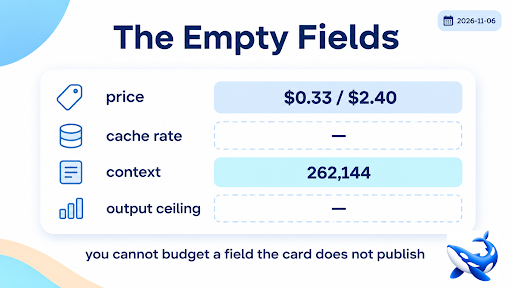
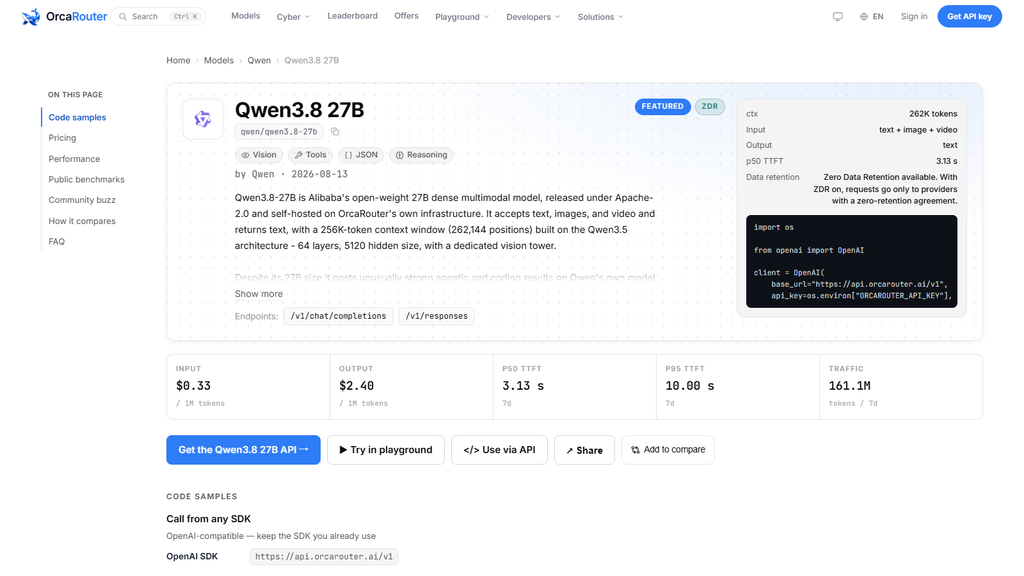
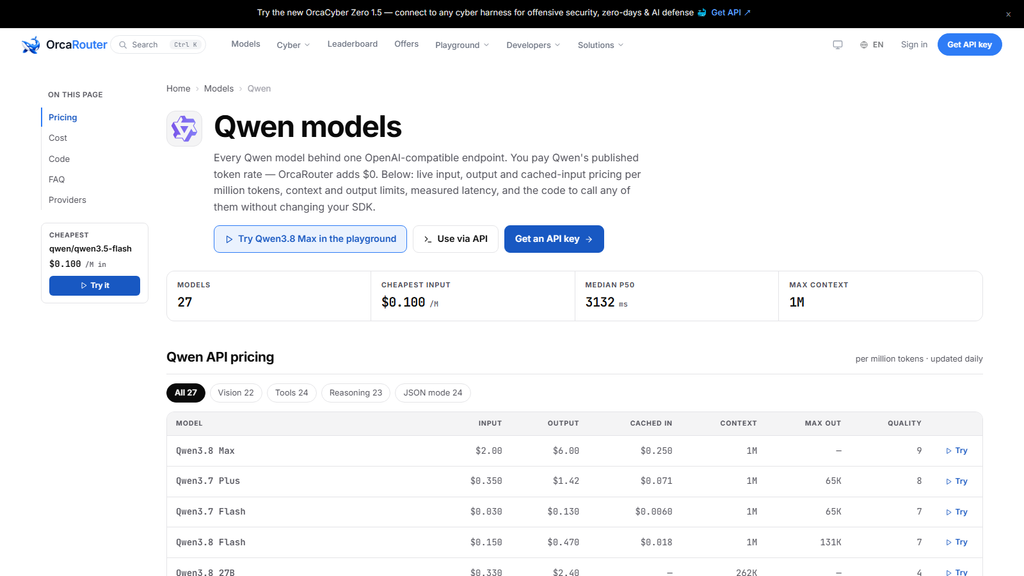
On OrcaRouter the card publishes four budget fields and fills two of them. A model card is a budget document, and the first thing to read is not the benchmark rows but the fields that are absent. Qwen3.8 27B, available through OrcaRouter at $0.33 in and $2.40 out, publishes a 262,144-token context and leaves two fields blank: no cache-read rate, and no maximum output. Everything else is precise — a quality score of 4, an error rate of 0.090%, a 29-row benchmark table — and those two dashes change how the card has to be evaluated.
They are not oversights. A card that does not publish a cache rate is telling you the feature does not exist on this row; a card that does not publish an output ceiling is telling you the limit is defined elsewhere or not at all. Either way, you cannot budget what it does not price.
What “no cache rate” costs you
A cache rate is not a discount you can assume. On a card that publishes one, a repeated prefix moves from the input rate to the cache rate — on the cheapest card in this catalogue that is 98% off the repeated tokens [OURS]. Without one, every request pays full input, whatever the prefix.
For a 27B specialist the practical consequence is a workload shape. If your application re-sends a large instruction block or a retrieved context on every call, this card’s effective input rate is $0.33 for all of it, with no ceiling on how much repetition costs. On a 100,000-token artefact sent twenty times, that is $0.66 of input per session — against $0.02 on a card with a 2% cache rate [OURS].
The reverse is also true: a workload that does not repeat itself is unaffected, and the absence of a cache rate is then simply a field you never needed.
What “no ceiling” does to a timeout
A maximum output field does two jobs: it caps a single answer, and it sets how long one request can run. Without it, the timeout in your client is the only limit, and that is a number you have to choose without knowing the model’s own bound.
The card’s throughput is 75.8 tokens per second at a p50 of 3,134 ms over the seven days ending November 5 [OURS]. If a request produces 8,000 tokens, the stream lasts about 106 seconds; a 30-second timeout kills it halfway. That is a client-side decision the card cannot help you make.
The honest approach is to set `max_tokens` yourself, per task type, and treat it as the ceiling the card does not publish.
What the card does publish, and it is a lot
A 29-row benchmark table. GPQA Diamond 90.5, LiveCodeBench v6 90.3, OSWorld-Verified 84.3, WebArena-Verified 64.8, SWE-bench Pro 61.7, Terminal Bench 2.1 73, AA Coding 68.1 — and, at the other end, AA Intelligence 20.1, HLE 33.9 and a `terminalbench_v4_0` of 5.56 [VENDOR].
That spread is the card’s personality. A 27B checkpoint that answers graduate science at flagship level and scores in the bottom fifth of a general index is a specialist, and the wide table is how it says so.
A micro-error rate. 0.090% over seven days is the lowest in this batch and one of the lowest in the catalogue [OURS]. For batch pipelines with no retry, that matters more than any benchmark row.
A modest traffic base. 161.1 million tokens in seven days [OURS] — small, which is what a specialist looks like next to a general-purpose card moving tens of billions.
How to work around a blank field
A missing number is not a blocker if you replace it with your own.
For the output ceiling: set `max_tokens` per task and treat it as the limit the card does not publish. A summariser at 2,000 and a report at 40,000 are two configurations, not one.
For the cache: assume none and design the prompt to be short. If you control the client, you can also test empirically — send the same prefix twice and compare the reported input tokens on each call; a drop means a cache exists even if the page does not price one.
For the rest: the card publishes everything else, including the two numbers that matter most to a batch pipeline — a 0.090% error rate and a 262,144-token window [OURS].
A card with blanks is not a bad card; it is a card whose evaluation you have to finish yourself.
The fields that are not blank
It is worth listing what the card does publish, because the two blanks can overshadow a strong sheet.
Quality score 4 out of 10 — low, and stated. A card that scores itself low is telling you where it belongs: inside its class, not outside it.
Error rate 0.090% — the lowest in this batch, and the single most decision-relevant number on a batch pipeline.
Throughput 75.8 tokens per second at a 3,134 ms median — serviceable, not fast.
Modality: text, image and video in. Video is rare at this price, and it broadens the card beyond pure text work.
Benchmarks: 29 rows. The largest table in the batch, with both its strengths and its failures published.
Read together, the sheet argues for one thing: a batch specialist with an unusually clean error column, evaluated on its own terms. The blanks are a caveat, not the character — and a card whose worst feature is a missing field is in better shape than one whose worst feature is a published failure.
The number to carry away
Two blank fields. No cache rate, no output ceiling — and both are things you can replace with your own numbers: a `max_tokens` you choose, and a cache test you run. The card’s honesty about what it does not publish is more useful than a fabricated figure would have been. A card that leaves a field empty is telling you it has not priced the feature, which is a different statement from pricing it at zero.
The takeaway
Qwen3.8 27B publishes $0.33 / $2.40 and a 262,144-token context, and leaves two budget-critical fields blank: no cache rate and no output ceiling. Read those dashes as constraints — every repeated token pays full price, every runaway answer is bounded only by your client — then decide whether the specialist table and the 0.090% error rate are worth a card you cannot fully price in advance.